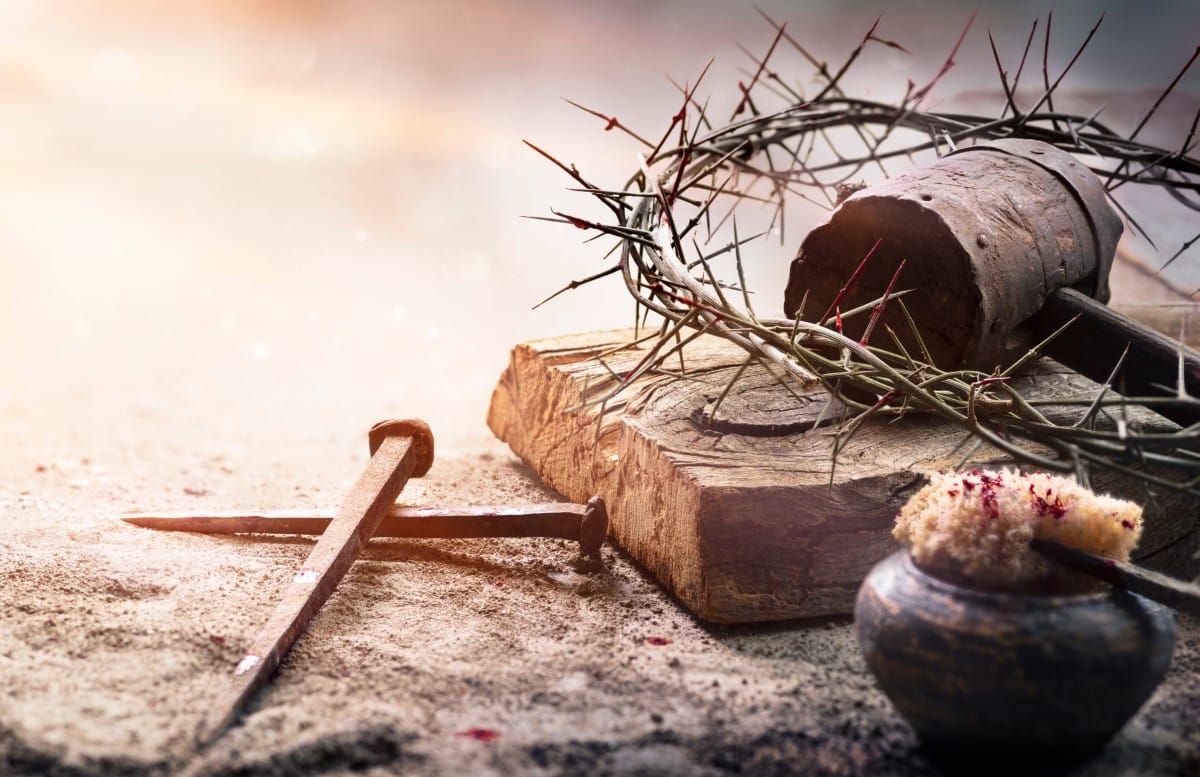

Why did Jesus have to die? It’s a question that sounds simple on the surface — you’ve probably seen it on a bumper sticker or a church sign — but if you actually sit with it, it’s anything but simple. And if you’re someone who has been trying to feel close to God and it still isn’t working, the answer to that question might be the very thing that changes that.
Here’s what I’ve come to believe: the gap a lot of us feel with God isn’t closed by trying harder. It’s closed by understanding what he actually did — and why it was necessary.
Why did Jesus have to die — couldn’t God just forgive without it?
This is one of the most common objections, and it’s a fair one. Why couldn’t God just wave his hand and say, “It’s fine, I forgive everyone”? The answer has everything to do with who God actually is — not just who we imagine him to be.
We tend to think of God as basically like us, just bigger and better. But the Bible describes him as so completely pure, so wholly other, that he lives in what 1 Timothy calls “unapproachable light.” The prophet Isaiah caught a glimpse of God in his throne room and his immediate response wasn’t wonder — it was devastation. “Woe is me, for I am lost… for my eyes have seen the King.” The gap between himself and God was suddenly undeniable.
That gap is real. And a God who is truly just can’t pretend it doesn’t exist any more than a good judge can look at a guilty person and say, “I like you, so never mind.” That’s not love — that’s corruption. Real love and real justice had to meet somewhere.
They met at the cross.
When people say “Jesus died for your sins,” what that means at its core is this: God — in the person of Jesus — stepped off the bench, so to speak, and paid the fine he himself had just imposed. Not because we earned it. Not because we were doing well enough. Scripture says plainly that while we were still in active rebellion against him, Christ died for us.
Why did Jesus have to die specifically — what made his death different?
Thousands of people were crucified in the ancient world. What made the death of Jesus different wasn’t just the physical suffering — it was what happened spiritually in that moment.
Jesus was fully human, which meant he could stand in as a genuine representative for humanity. But he was also fully God, which meant his sacrifice could carry the weight of an infinite debt — the kind that piles up when finite people sin against an infinite God. That’s why the dual nature of Christ isn’t just interesting theology. It’s the whole mechanism.
On the cross, something happened that Jesus himself gives us a clue about when he cries out, “My God, why have you forsaken me?” For a moment, he bears the full weight — the shame, the rebellion, the accumulated wrong of all of human history — and feels what separation from God actually is. So that we never have to.
That’s not divine child abuse, as some critics put it. It’s God absorbing the cost himself. The judge came down off the bench and wrote the check.
Why did Jesus have to die for me personally — and what do I do with that?
This is where it gets personal — and where a lot of people get stuck.
I spent years in church believing the right things. If you had asked me the questions, I had the answers. But I didn’t have the relationship with God. Something was still in the way — some things intellectual, some emotional — and I stayed on the edges of faith for a long time without really knowing why.
What I eventually understood is that what Jesus did on the cross is a gift. And a gift sitting in front of you, beautifully wrapped, is still not yours until you take it.
Taking it doesn’t mean performing. It doesn’t mean getting your doubts resolved first or cleaning yourself up. It means coming to God with open hands and saying — I know I’m not you. I’ve been living like I am. I believe you did something about that. I want the relationship.
And then something shifts. Not because of effort — because of honesty.
If Christianity has felt oppressive or distant, something is missing. The whole reason for the cross is relationship — not behavior modification, not rule-following, not trying harder. He wants to be known by you.
Carey and I go deep on all of this in this week’s episode of Barriers to Belief — the holiness of God, the logic behind the cross, the “divine child abuse” objection, what actually happened spiritually on that day, and what it looks like to truly accept what Jesus did. It’s a conversation I think a lot of people need.
Watch Series 2, Episode 3 of Barriers to Belief:
If you’re on the edges of faith — believing some of the right things but not yet experiencing the relationship — I’d love to help you figure out what’s in the way. That’s exactly what we do at DoubtLess Faith. Whether it’s an intellectual question still unresolved or an emotional block you haven’t been able to name, there’s a path forward.
Written by Kristen Davis, Ph.D. | Founder, DoubtLess Faith